APOPTOSIS
• Explanation.
• Regulation.
• Morphological features.
• Role in development and adulthood.
1. APOPTOSIS AND ITS REGULATION
APOPTOSIS (from Greek: apoptosis; “falling off” of leaves from trees) is a term for the programmed cell death. It represents autodestructive programme leading to fragmentation of the nuclear DNA and decay of the cell into many tiny apoptotic bodies. The reason why every cell of our organism carries this dangerous and self-destructive programme is likely that it provides the efficient protection of multicellular organisms against viral infections. Destruction and fragmentation of the nuclear DNA in the infected cell (that could infect the other cells) can eliminate the infection although infected cell is killed. 
APOPTOSIS REGULATION
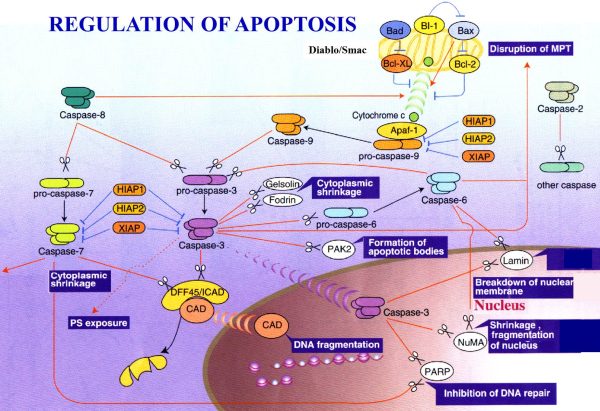
In response to a death“ signal (after a cursor touches the image in right), cell caspases (executive apoptotic enzymes) become activated. Interaction of regulatory molecules is very important. Proapoptotic factors (e.g., Bad, Bax, p53, Bcl-XS, Fas, Apopain) can trigger apoptosis while antiapoptotic factors (e.g., Bcl-2, BCL-XL, Bag-1) can suppress it. The figure below illustrates caspases responsible for different roles (this knowledge is not required in final examination).