DIFFERENTIATION
Differentiation enables formation of diverse cell types in the multicellular organism, i.e .to form cells with different specialization which is a prerequisite for formation of tissues and organs that constitute the entire organism.
1. CHARACTERIZATION OF CELL DIFFERENTIATION
Differentiation (from Latin differo, to differ) is the process of gradual specialization of cells to functions definitively different from those of the original cell type.
Example: Ectoderm → neuroectoderm → neural crest → odontoblasts
The cells of the vertebrate body exhibit more than 200 different modes of specialization.
The cells are specialized for specific functions. More cells types have to co-operate to perform complex functions.
|
Example: The neuromuscular junction involves three types of cells:
|
|
|
The development of tissue begins at the moment of fertilization, ie. upon the union of a spermatozoon with an ovum. Male and female pronucleus fuse and form the first nucleus of the first cell (zygote) of the new organism. All tissues develop from one zygote. |
|
 |
|
|
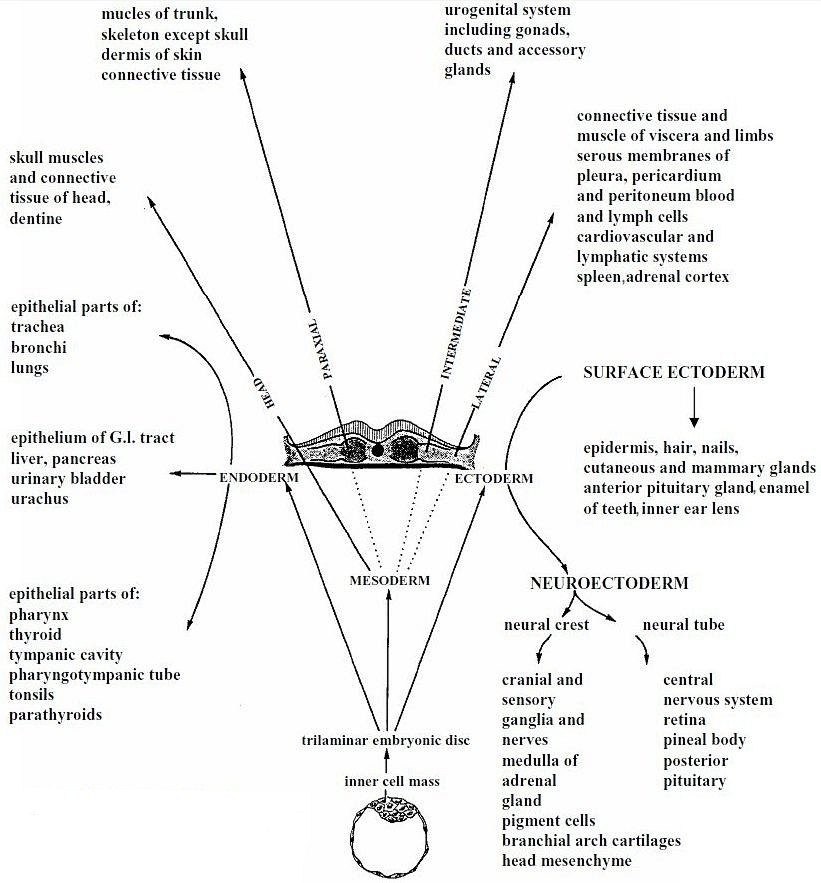
Morula → blastocyst (trophoblast and inner cell mass) → epiblast beneath it hypoblast– the bilaminar embryonic disc → |
|
|
Fig. Scheme illustrating the origin and derivatives of the three germ layers ectoderm, endoderm,and mesoderm. Cells from these layers make contributions to the formation of the different tissues and organs, e.g., the endoderm form the epithelial lining of the gastrointestinal tract and the mesoderm gives rise to its connective tissues and muscles (Moore, K. L., Persaud, T. V. N. The developing human. Clinically oriented embryology). |
|
|
|