
PROLIFERATION
Proliferation, i.e. repetitive cell divisions, allows to form a multicellular organism from a single cell (zygote).
1. PROLIFERATION, CLEAVAGE
Proliferation is multiplication of cells through repetitional cellular divisions (mitosis).
Fertilized egg must divide many times to form a multicellular organism. The human body contains 35 bilions of cells (35 x 1012). Rapid proliferation is characteristic of early developmental stages.
A special example of cell proliferation is a cleavage. Fertilization triggers an unusually rapid sequence of cell divisions of a single giant cell (zygote) that cleaves, without growing, to generate an embryo consisting of a large amount of smaller cells; the surface is still covered by the zona pellucida (see Fig.).
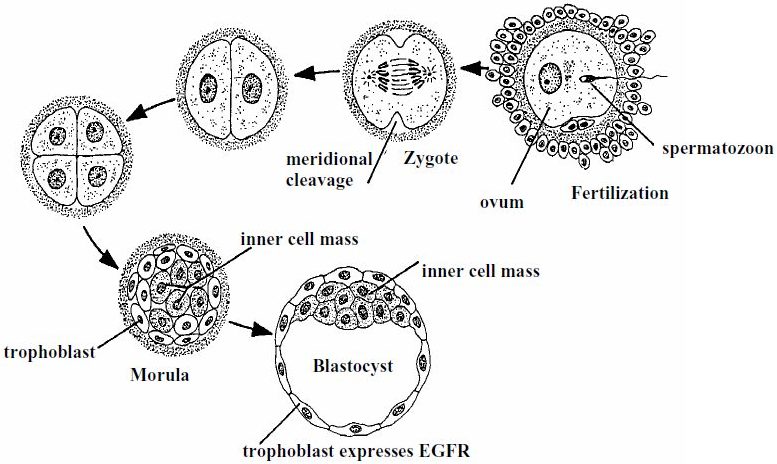
The cleavage can proceed rapidly because the principal macromolecule to be synthesized is DNA. The cytoplasm of the oocyte contains a large amount of mRNAs which enables the embryos´ development not to be retarded by waiting for transcription of new genes (maternal mRNAs are used to produce the necessary proteins during early phases of ontogenesis). The cleaving embryo is almost entirely dependent on the RNAs, proteins, membranes, and other materials that had been available in the cytoplasm of the egg.