
PROLIFERATION
Proliferation, i.e. repetitive cell divisions, allows to form a multicellular organism from a single cell (zygote).
3. PARTICIPATION OF PROLIFERATION IN MORPHOGENESIS
Uneven distribution of proliferating and non-proliferating cells participate in shaping the developing organs, i.e. on their morphogenesis incl. cerebral vesicles or tooth morphogenesis (see below).
Primary enamel knot is an embryonic structure formed by cluster of non-dividing cells situated in the centre of the developing tooth. Cells of the enamel knot do not proliferate but they produce FGF-4, which stimulates proliferation of surrounding inner enamel cells.
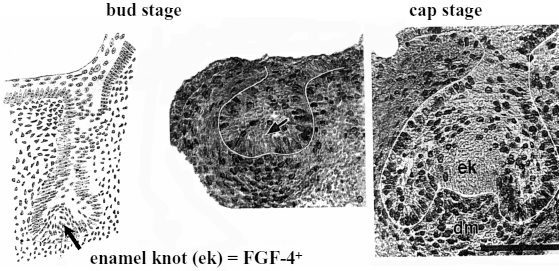

Proliferation of the inner enamel epithelium results in folding and downgrowth around the enamel knot. Bilateral proliferation of the inner enamel epithelium (in combination with non-dividing enamel knot) is responsible for formation of a characteristic bell-shape of the enamel organ – shaping the developing tooth incl. its crown.
Unequal rate of cell growth in different parts of developing structures and uneven distribution of proliferating and resting areas (e.g. in the epithelium) are necessary for formation of a resulting shape of developing teeth.